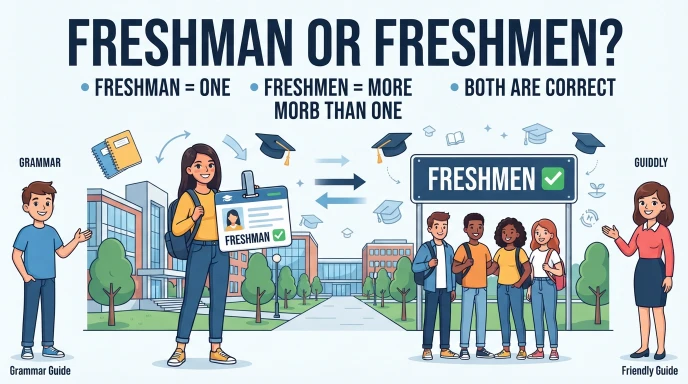
Freshman and freshmen are both correct, but “freshman” is singular and “freshmen” is plural. The right choice depends on if you are talking about one first-year student or more than one.
Freshman or Freshmen: Quick Answer
- Freshman = one first-year student
- Freshmen = two or more first-year students
Examples:
She is a freshman in college.
They are freshmen in college.
The key difference is simple: freshman = one, while freshmen = more than one.
Definition and Meaning of Freshman and Freshmen

What does “freshman” mean?
Freshman is a noun for a student in the first year of high school, college, or another educational program.
My brother is a freshman at college.
It can also be used as an adjective:
She joined the freshman class.
What does “freshmen” mean?
Freshmen is the plural form of freshman.
The freshmen attended an orientation program.
It refers to two or more first-year students.
Freshman vs Freshmen at a Glance
| Word | Number | Meaning |
| Freshman | Singular | One first-year student |
| Freshmen | Plural | Two or more first-year students |
The Origin of Freshman and Freshmen
The word freshman combines fresh, meaning new or inexperienced, with man, which historically referred to a person.
The term came to describe someone who was new to a school, college, or university. Freshmen developed as its plural form.
Today, freshman and freshmen are especially common in American English, particularly when discussing the first year of high school or college.
British English vs American English
There is an important regional difference.
| Term | American English | British English |
| Freshman | Common | Less common |
| Freshmen | Common | Less common |
| First-year student | Also common | Very common |
In the United States, freshman and freshmen are widely used.
In the UK, people often say first-year student instead.
For example:
American English:
She is a freshman at university.
British English:
She is a first-year student at university.
The words are not incorrect in either variety, but first-year student is often more natural internationally.
Which Version Should You Use?
Use freshman when talking about one first-year student.
John is a freshman.
Use freshmen when talking about multiple first-year students.
John and Sarah are freshmen.
Use “freshman” for one person
- He is a freshman.
- She became a freshman this year.
- My friend is a freshman at the university.
Use “freshmen” for multiple people
- The freshmen arrived early.
- The school welcomed its new freshmen.
- Several freshmen joined the club.
Common Mistakes with Freshman and Freshmen
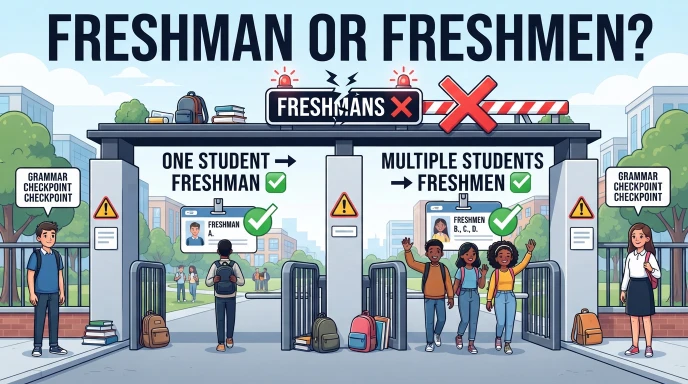
Mistake 1: Using “freshmen” for one person
❌ She is a freshmen.
✅ She is a freshman.
Why?
You are talking about one student, so the singular form freshman is needed.
Memory tip:
One = freshman.
Mistake 2: Using “freshman” for multiple students
❌ The freshman attended orientation.
If you mean many students:
✅ The freshmen attended orientation.
Mistake 3: Confusing freshman with freshwoman
In modern English, freshman can refer to a student of any gender.
You do not normally need to say “freshwoman.”
She is a freshman.
He is a freshman.
Everyday Examples of Freshman and Freshmen
In school writing
I am a freshman this year.
The freshmen attended their first school event.
In college
My sister is a freshman at college.
The college organized an event for new freshmen.
In emails
The orientation is designed for incoming freshmen.
In news writing
The university welcomed hundreds of new freshmen.
In everyday conversation
My cousin is a freshman.
We met several freshmen at the event.
Is Freshman Gender-Neutral?
Yes. Freshman is commonly used for a first-year student regardless of gender.
For example:
Emma is a freshman.
David is a freshman.
The plural is:
Emma and David are freshmen.
For more inclusive or international writing, first-year student is also a useful alternative.
Freshman or Freshmen: Google Trends & Usage Data
People often search “freshman or freshmen” because the two forms look almost identical and differ mainly in their endings.
The main distinction is grammatical:
- Freshman → singular
- Freshmen → plural
Usage also varies by region. Freshman and freshmen are especially common in American educational contexts, while first-year student is often preferred in British and international contexts.
Exact search-volume figures change over time and by location, so current Google Trends data should be checked for a specific country and date range rather than using unsupported numbers.
Quick Comparison: Freshman vs Freshmen
| Feature | Freshman | Freshmen |
| Number | Singular | Plural |
| Students | One | Two or more |
| Example | He is a freshman. | They are freshmen. |
| Common in US English | Yes | Yes |
| UK alternative | First-year student | First-year students |
Key Takeaways
- Freshman is singular.
- Freshmen is plural.
- Use freshman for one first-year student.
- Use freshmen for two or more first-year students.
- Both terms are common in American English.
- First-year student is common in British and international English.
- Freshman can refer to a student of any gender.
People Also Ask: Freshman or Freshmen
1. Is it “freshman” or “freshmen”?
Both are correct. Freshman is singular, while freshmen is plural.
2. Is one person a freshman or freshmen?
One person is a freshman.
3. What is the plural of freshman?
The plural of freshman is freshmen.
4. Is “freshmen” only for males?
No. Freshmen can refer to first-year students of any gender.
5. Can a girl be called a freshman?
Yes. Freshman is commonly used for both male and female first-year students.
6. Is freshman American or British English?
Freshman is especially common in American English. British English often uses first-year student.
7. Is “freshman year” correct?
Yes. Freshman year refers to a student’s first year, especially in the American education system.
8. Should I say “freshman students” or “freshmen”?
Both can be used, but freshmen is usually enough when referring to multiple first-year students.
9. What is the difference between freshman and freshmen?
Freshman refers to one first-year student, while freshmen refers to more than one.
10. Is “freshmen” grammatically correct?
Yes. Freshmen is the standard plural form of freshman.
Conclusion: Freshman or Freshmen?
Freshman and freshmen are both correct, but they are not interchangeable. Use freshman when you are talking about one first-year student and freshmen when you are talking about two or more.
For example, you can write, “She is a freshman,” but you should write, “They are freshmen.” This simple singular-versus-plural rule makes the difference easy to remember.
The terms are especially common in American English. In British and international contexts, first-year student or first-year students may sound more natural.
if you are writing a school assignment, college article, email, or educational website content, choosing freshman or freshmen correctly will make your writing clearer and more accurate.
DISCOVER MORE ARTICLE HERE!
- Drier or Dryer: Which Is Correct?
- Led or Lead: Which Spelling Is Correct?
- Highschool or High School? Which One Is Correct?

I’m Orin Blake, a writer with a passion for making English grammar simple, practical, and easy to understand. I enjoy breaking down confusing words, spelling differences, and everyday language questions into clear, reader-friendly guides. My goal is to help students, professionals, and curious learners write with greater confidence and accuracy.